What a New Stanford Study on Memory, the Vagus Nerve, and the Microbiome Might Mean for Iyengar Yoga Practice
Musings by bashir anastas
Your brain might be forgetting things because your gut stopped texting it. A new study shows how to reverse this. Iyengar Yoga might have something to say about it.
That’s the short version of a wild new study from Stanford that just dropped in Nature. Researchers found that age-related memory loss in mice doesn’t start in the brain—it starts in the intestines. And here’s the kicker: they reversed it by jumpstarting the vagus nerve, the main communication highway between your gut and your head.
This offers a framework for something we’ve been doing for years at Adeline Yoga without necessarily having the science spelled out. But let’s be clear about what this study does and doesn’t tell us.
What Stanford Actually Found
Young mice living with old mice started getting dumb. The scientists traced this to the gut microbiome. As mice age, a bacterium called Parabacteroides goldsteinii takes over and starts pumping out inflammatory compounds. These compounds mess with the vagus nerve—think of it as the fiber optic cable running from your intestines to your brain—and when that connection goes down, the hippocampus (your brain’s memory center) stops working properly.
The mice became forgetful. Just like your uncle who keeps asking if you’re still single at every Thanksgiving.
But here’s where it gets interesting: the researchers fixed it. They stimulated the vagus nerve using gut hormones (CCK and GLP-1 agonists—drugs in the Ozempic family), and the old mice performed like young mice again. They also tried antibiotics and even a targeted virus that killed just the problematic bacteria. Memory came back.
The researchers call this an “interoceptive failure”—the brain losing its ability to sense what’s happening inside the body. Just like your vision and hearing decline with age, so does your internal sensing.
What This Study Does NOT Prove
Let’s get real: the Stanford team used direct electrical vagus nerve stimulation in mice. They manipulated the microbiome with antibiotics and fecal transplants in sterile lab conditions. These are precise, controlled interventions.
Nobody has shown that pranayama reverses hippocampal dysfunction, kills P. goldsteinii, or restores vagal signaling in this specific pathway. Nobody even knows if this mechanism works the same way in humans. P. goldsteinii lives in human guts, but we don’t know what it does there.
The gap between a surgically implanted electrode in a lab mouse and your Wednesday 7am Ujjayi practice with Kim is massive. What the study offers is a roadmap for asking better questions about why practices involving breath, gut awareness, and nervous system regulation might actually matter.
Interoception: The Bridge Between Science and Practice
Interoception is where the lab and the mat start speaking the same language. In neuroscience, it means your brain monitoring your internal organs—gut activity, heart rate, breathing rhythm, visceral tension. The Stanford team says age-related memory loss is partly an interoceptive breakdown: your brain stops getting clear signals from your body.
Iyengar Yoga has been training this for decades. When B.K.S. Iyengar talked about the “inner eye” and “meditation in action,” he was describing exactly this: the deliberate cultivation of internal body awareness. Sensing your diaphragm release, your abdominal wall soften, your back ribs expand. In modern language, this is interoceptive training.
Pranayama and the Vagus Nerve: What We Actually Know
While Stanford used direct electrical stimulation, plenty of research shows that slow, controlled breathing enhances vagal tone. You don’t need to stick electrodes in your neck.
Slow breathing at around six breaths per minute consistently increases heart rate variability (HRV)—a reliable marker of vagal activity. A 2018 review in Frontiers in Human Neuroscience confirmed links between slow breathing, increased HRV, better brain wave patterns, and improved emotional regulation.
Longer exhales shift your nervous system toward parasympathetic dominance (rest-and-digest mode). A 2021 study in Scientific Reports found that deep, slow breathing with a low inhale-to-exhale ratio increased vagal activity in both young and older adults—with older adults showing bigger benefits.
Specific pranayama techniques—alternate nostril breathing, Bhramari (humming), Ujjayi—enhance parasympathetic markers and reduce fight-or-flight activation. A 2025 review in Pharmacological Research confirmed that slow pranayama promotes vagal tone through well-understood mechanisms.
Shanmukhi mudra (described in Light on Pranayama) offers a complementary technique: practitioners use fingers to gently seal the eyes and ears, while maintaining slow, rhythmic breathing.
Often combined with bhramari (humming bee breath), the practice creates dual vagal stimulation—sensory withdrawal through the hand seals plus vocal vibration through the hum, targeting vagal branches that innervate the eyes, ears, and larynx.
No published studies have yet measured vagal tone during shanmukhi mudra specifically, but the mechanistic logic is sound: the technique leverages multiple established pathways of vagal activation in a single integrated practice.
Iyengar Yoga pranayama does a lot of this naturally: long exhales, pauses after the breath out, the throat and chest work in Ujjayi, quieting the eyes and face. Obviously not the same as electrodes in your neck. But same nerve, overlapping mechanisms, measurable effects.
Beyond the Vagus: A Speculative Detour
The Stanford team only studied the vagus nerve. What follows is educated speculation, not science.
The trigeminal nerve innervates most of your face, sinuses, and jaw, and also modulates brain state through autonomic circuits. In Iyengar practice, we constantly work with the face: softening the jaw in headstand, releasing the tongue in shoulderstand, quieting the eyes in supported bridge pose, using eye wraps in restorative work.
If the Stanford logic holds—that restoring cranial nerve signaling can improve brain function—then maybe the Iyengar emphasis on facial softening taps into parallel pathways. Nobody’s tested this. But it’s worth asking.
The Gut, the Abdomen, and Getting Older
The Stanford study showed that germ-free mice—raised without gut bacteria—didn’t develop memory problems. And young mice colonized with an old microbiome got dumber. The gut environment directly shapes brain function.
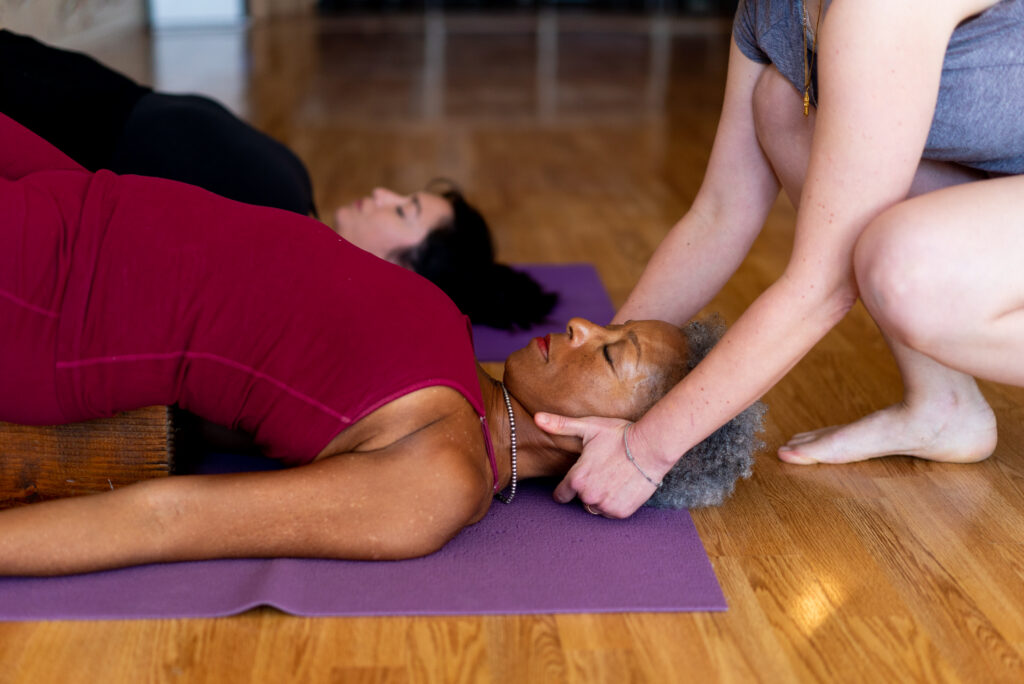
Iyengar Yoga teachers have long paid attention to the abdomen: forward bends that quiet without crushing the belly, gentle twists that encourage movement without strain, restorative backbends that lift and aerate the abdominal cavity. Supported Viparita Karani, Setu Bandha over bolsters, Supta Baddha Konasana —all these may support circulation and gut motility.
Plausible? Yes. Proven? No. But the Stanford team identified the gut as critical to cognitive health, and we have practices that support gut conditions. Connect the dots.
What To Actually Do With This Information
These aren’t medical prescriptions. They’re invitations to bring scientific curiosity to what you already do.
- Treat pranayama as interoceptive training
When you practice Viloma or Ujjayi, don’t just think “air in, air out.” Notice the diaphragm ascending, the organs responding to each breath phase, the heart rhythm changing with exhalation. Each conscious observation is an interoceptive signal—training your nervous system to pay attention inward.
- Emphasize the long exhale
The research converges on one point: slow, extended exhalation is the most reliable way to boost parasympathetic activity without drugs or electrodes. In pranayama, especially in supported positions, let the exhale be unhurried. If you practice breath retention, the pause after exhalation is especially associated with vagal engagement.
- Use restorative sequences to quiet the abdomen
Supported Viparita Karani, Setu Bandha on a bolster, Supta Baddha Konasana with the chest elevated—all lift and decompress the abdominal cavity. Nobody’s studied whether these poses influence the gut microbiome, but the Stanford logic says gut health matters for brain function. At minimum, these poses create physiological quiet that may support a healthier internal environment.
- Soften the face, soften the brain
In Savasana, in supported inversions, in seated pranayama: deliberately release the jaw, tongue, and skin around the eyes. Whether this taps into trigeminal pathways the way vagal stimulation does is unknown. But the Iyengar tradition’s consistent emphasis on facial softening as a gateway to mental quiet deserves investigation.
- Practice regularly, not just intensely (sounds familiar?)
The Stanford findings suggest cognitive resilience depends on sustained gut-brain communication—not a single dramatic intervention. Translation: consistent practice over months and years probably matters more than any single heroic class or workshop.
Closing Thoughts
Science is now drawing molecular maps from the intestines to the hippocampus, from a bacterium in the colon to a memory in the brain. Iyengar Yoga has long been drawing experiential maps from the diaphragm to the mind, from the jaw to the brain, from the gut to consciousness. These are different kinds of maps, made with different tools.
But when the territory starts to overlap, it’s worth paying attention.
The Stanford study doesn’t prove your pranayama practice prevents memory loss. What it does is offer a damn good reason to keep exploring the inner geography of breath, organs, and awareness with the rigor and curiosity the Iyengar tradition has always demanded.
————————-
Disclosure: This article started as my idea rough-drafted using Perplexity (which used ChatGPT 5.1.). I then handed it to Claude Opus 4.6—which I’m frankly obsessed with—for major revisions, proper citations, and making sure the science was actually correct. Final edits by me. bashir anastas.
References
Primary study: Cox, T.O., Devason, A.S., et al. (2026). “Intestinal interoceptive dysfunction drives age-associated cognitive decline.” Nature. Published March 11, 2026. DOI: 10.1038/s41586-026-10191-6
Stanford Medicine press release: med.stanford.edu/news/all-news/2026/03/gut-brain-cognitive-decline.html
Zaccaro, A., et al. (2018). “How Breath-Control Can Change Your Life: A Systematic Review on Psycho-Physiological Correlates of Slow Breathing.” Frontiers in Human Neuroscience, 12, 353.
Renée-Pierre, L., et al. (2021). “Benefits from one session of deep and slow breathing on vagal tone and anxiety in young and older adults.” Scientific Reports, 11, 19267.
Gerritsen, R.J.S. & Band, G.P.H. (2018). “Breath of Life: The Respiratory Vagal Stimulation Model of Contemplative Activity.” Frontiers in Human Neuroscience, 12, 397.
Scientific American coverage: scientificamerican.com/article/the-gut-microbiome-may-influence-brain-aging-mouse-study-suggests/
shari ser says
wonderful article Bashir!! concise and simplified for understanding and great yogic tie in! Bravo.